
The Elephant Rope: The Myopia of Fear and its Consequences
- Greg Nakaska
- Aug 26, 2025
- 6 min read
Updated: Aug 27, 2025
I was having a conversation the other day with a teacher friend of mine. They have often lamented the challenges of working with parents (though they are gracious and patient), they said something that both stood out to me, and I couldn’t help but challenge: “Often these parents who are difficult to work with I can’t be upset with them, because I know that they have good intentions for their children, and are doing their best out of love” The comment didn’t sit well with me, given the described behaviours of the parents; I responded “I agree with you, the parents have good intentions, but they are not acting out of love, but fear”. There was a brief pause as my friend reflected, they then said, “you’re right, it is fear driven”. We have often heard “the road to hell is paved with good intentions” and indeed, good intentions alone can lead us down dark paths as our good intentions can in fact be motivated by fear rather than love and this is often when we get into trouble. So, we must reject fear and find courage, without courage we will always find ourselves down the path fear that leads, which is a slow ossifying death.
It is always important to define terms. Unfortunately, too often people think that courage is the absence of fear, however, if that were true, what would be virtuous about that? Absolutely nothing! Courage is when fear is present but we act in spite of it. If a person has social anxiety and they make themselves vulnerable by attending a social engagement then they have exhibited the virtue of courage, even though to many, this action may just be another Saturday night out with friends.
Fear and the Bayesian Trap
Today we have a great lack of courage which has brought us to a place of ossification and stagnation. Many of us have probably heard about the parable of the Elephant Rope. Trying to track down the origins of this story is quite difficult, but it goes like this:
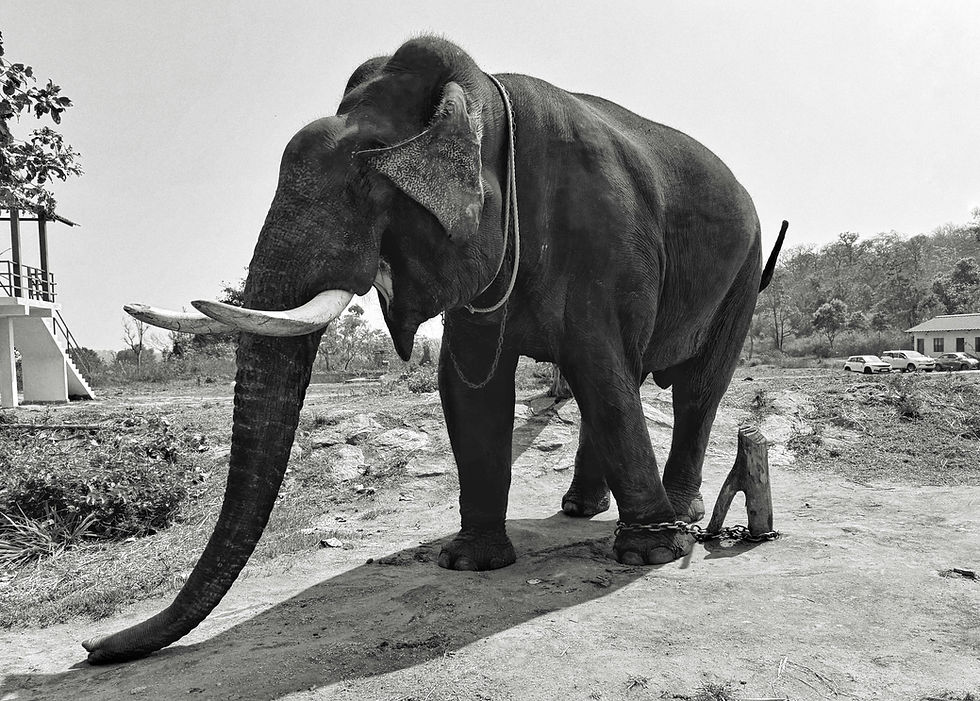
As a man was passing the elephants, he suddenly stopped, confused by the fact that these huge creatures were being held by only a small rope tied to their front leg. No chains, no cages. It was obvious that the elephants could, at anytime, break away from their bonds but for some reason, they did not.
He saw a trainer nearby and asked why these animals just stood there and made no attempt to get away. “Well,” trainer said, “when they are very young and much smaller we use the same size rope to tie them and, at that age, it’s enough to hold them. As they grow up, they are conditioned to believe they cannot break away. They believe the rope can still hold them, so they never try to break free.”
The man was amazed. These animals could at any time break free from their bonds but because they believed they couldn’t, they were stuck right where they were.
If one prefers a more empirical approach, then I would refer to Derek Muller’s explanation by use of what he calls “The Bayesian Trap”. Bayes theorem is a mathematical theorem to determine the probability of something through multiple results, basically as a way to confirm false positives/negatives. However, with Bayes theorem no matter how many results you run the probability will never reach 0% or 100% (depending on which direction you’re measuring). If you want a more thorough explanation, you can have Muller explain it fully here (https://youtu.be/R13BD8qKeTg?si=H3kL0521iVerVZ-P). For us as individuals, the Bayesian trap is simple, if you encounter failure, push back etc. multiple times you come to believe that whatever you have experienced is the rule and become blind to the potential of a different possible outcome. Just as the elephant is blind to the fact that it is an adult and it’s circumsances have changed, we too make the same false assumption, i.e. that this is a universal rule, rather than a consequence of specific variables. Ironically, as Muller explains, Baye himself never published his theorem, thinking it was not important or insignificant, it was his family who published it after his passing, and it became an important theorem in mathematics.
We experience something, apply meaning and then make a rule, and often time, we then teach that rule on others. Then even without experiencing it for themselves that person becomes a victim of our own Bayesian trap. We lack imagination, and we lack the courage to be vulnerable and pursue different possibilities. We have come to believe (falsely), that: “these are the rules for life” and dare not deviate from them. Here is the reality, there are no rules, only choices and the consequences of those choices. We either pursue something because it is good, beautiful and true (even if it is perhaps difficult), or we don’t, and if we don’t, we will experience the consequences of those choices.
Scarcity Mindset and Fear
Right now, in the “developed” world we are in a phase of slow death brought on by a lack of courage, and a sense of complacency fueled by a scarcity mindset. This elephant rope we have bought into has infected our workplaces and organizations, but perhaps most importantly for those reading, many of us as individuals are in a place of slow death driven by fear. We have become extremely risk adverse and as a result, rather myopic. We have now gotten to the point where we believe that abundance is a zero-sum game; one where the pie is only so big and it can’t get any bigger, just pause to look around our current social climate.
We are creatively bankrupt with remakes of movies and videos games being the norm, companies suck their customers dry an ever-increasing number of unoriginal products becoming a subscription or lease (can you even buy things anymore?), all while freezing the wages of their employees. Ghosting has steadily become a common form of rejection for both personal relationships and job applications alike (as people fear retaliation for rejection), people’s personal perspectives vs. what the express publicly are not congruent due to fear of being cancelled. That doesn’t even include the highly curated image of social media, mostly only showing the best parts of our lives, creating a false image of everyone’s life being better than our own experience. In an age when everybody speaks about “authenticity” as one of the greatest values, ironically few have the courage to be open, honest, and show up in the world as such.
This social deficit has impacted every part of our world, how many leaders in our countries can we really point to and say, “that is an impeccable person worth following!”, where are our inventors and entrepreneurs who look to solve real problems and make their creations accessible to the common person, or narrative creators such as the like as Tolkien? What about in our relationships? How many of us really show up honestly and vulnerably cultivating genuine relational intimacy, or do we preserve our ego, avoid intimacy (mental/emotional vulnerability) altogether, seeing the other increasingly as a set of criteria, almost like a product to be purchased or consumed for emotional, social (status), economic, mental or sexual gratification? All of this comes from an ever-increasing sense of scarcity with a diminishing sense of courage, leaving us with a narrowing vision where we grasp at control and certainty, holding tighter and tighter to less and less.
Despite my criticisms and concerns it is important to note the anecdote at the beginning; I believe that most of us have put ourselves in this cage of scarcity out of good intent. We want what is best for ourselves and our families, desiring safety and security, but when those good intentions are fueled by fear, we will only find ourselves tied to a small piece of string wrapped around a twig in the ground that we dare not remove.
In my next post I will shed light on what the alternative is, how we can have good intentions not led by fear, but by love, and how we can find courage and use it to move forward toward an uncertain future.
Sources:
Cox, Daniel A. “From Swiping to Sexting: The Enduring Gender Divide in American Dating and Relationships - the Survey Center on American Life.” The Survey Center on American Life - A nonprofit organization dedicated to understanding the way cultural, political, and technological changes are shaping the lives of ordinary Americans., March 7, 2025. https://www.americansurveycenter.org/research/from-swiping-to-sexting-the-enduring-gender-divide-in-american-dating-and-relationships/.
Iacurci, Greg. “‘ghosting’ Gets More Common in the Job Market: It’s Not a ‘Passing Fad,’ Report Says.” CNBC, February 29, 2024. https://www.cnbc.com/2024/02/29/ghosting-is-getting-more-common-in-the-job-market.html?msockid=27d94b17de41689303555812df6c69e0.
Kanojia, Alok. How can technology help mental health? Enlighted. YouTube, 2022. https://www.youtube.com/watch?v=9gTKOXLLdRc&t=2070s.
LeFebvre, Leah. “Ghosting as a Relationship Dissolution Strategy in the Technological Age.” Impact of Social Media in Modern Romantic Relationships, 2017, 219–36. https://doi.org/10.5040/9781978736375.ch-0014.
Manfredi, Red, Andrea Guazzini, Carla Anne Roos, Tom Postmes, and Namkje Koudenburg. “Private-Public Opinion Discrepancy.” Pub Med, November 25, 2020. https://pubmed.ncbi.nlm.nih.gov/33237944/.
Muller, Derek. The Bayesian Trap. Veritasium. YouTube, 2017. https://www.youtube.com/watch?v=R13BD8qKeTg.
Stephen. “The Elephant Rope.” Motivational Stories, June 17, 2011. https://academictips.org/blogs/the-elephant-rope/.
Timmermans, Elisabeth, Anne-Mette Hermans, and Suzanna J. Opree. “Gone with the Wind: Exploring Mobile Daters’ Ghosting Experiences.” Journal of Social and Personal Relationships 38, no. 2 (November 20, 2020): 783–801. https://doi.org/10.1177/0265407520970287.
Various. “The Productivity–Pay Gap.” Economic Policy Institute, May 15, 2025. https://www.epi.org/productivity-pay-gap/.
Weaver, Jackson. “Why Hollywood Will Never Stop Remaking, Rebooting and Recycling the Same Old Stories | CBC News.” CBCnews, August 17, 2025. https://www.cbc.ca/news/entertainment/hollywood-remakes-1.7610674.
Copyright © Greg Nakaska 2025


Comments